Training Tip: Must-Have Obstacles: Small Rolltop
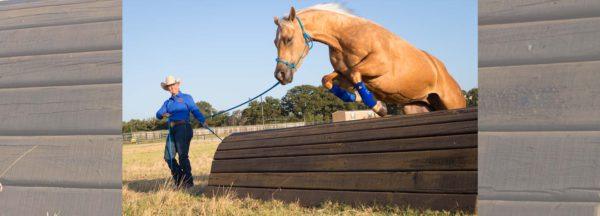
Having obstacles to work your horse over keeps training sessions fun and interesting for you and him. Plus, it allows you to work on practical skills you’ll need when you’re out exploring trails.
If you’ve got a set budget to work with or only a limited area in which to build a course, there are six obstacles that’ll get you the most bang for your training. The first obstacle I recommend is a log circle, the second is a small gully, the third is a curtain, the fourth is a staircase, the fifth is a stationary bridge, all of which we’ve covered in previous tips, and the sixth is a small rolltop.
Exposes: How well your horse can jump a small obstacle. A lot of horses will do arena work just fine, but when you ask them to start negotiating unfamiliar obstacles, they’ll often give you resistance. For that reason, asking a horse to jump a simple obstacle is a great way to test the control you actually have of his feet.
Initially, your horse will likely lean against you and pull on the halter as he’s going over the jumps. With practice, he’ll learn to stay light.
Obstacles such as this also teach the horse to pick up his feet and pay attention to where he’s going. Your horse may bump his legs against the jump a few times or even stumble. That’s OK. Let him figure out how to move his feet and control his body going over the obstacle. Don’t micromanage his feet—teach him to be responsible for himself.
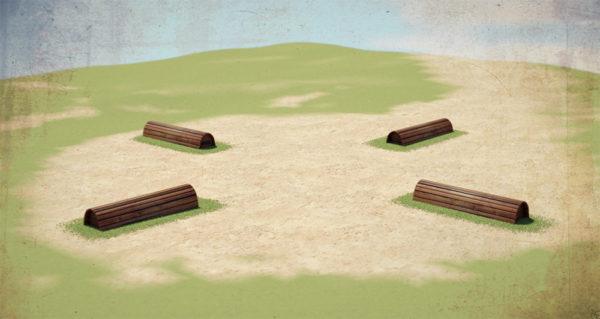
Dimensions: My small roll tops are 2½ feet high, 1 foot wide and 4 feet long. I have four of them spaced evenly in a circle. That allows me to isolate a jump and work on having a horse go over just one roll top. Or, I can send him around the jumps in a circle, which teaches him to jump and manage his feet while developing a rhythm.
Practical Application: When you come across an obstacle on the trail that is too large for your horse to step across, he’ll be comfortable jumping it. As a general rule, as long as an obstacle isn’t higher than a horse’s knees, I expect him to walk over it. For anything that’s above his knees, he’ll need to pick up a trot and jump over it.
Looking for more training tips? Check out the No Worries Club. Have a training question? Send it to us at [email protected].
