Training Tip: Doing Rollbacks on the Fence With a Blind Horse
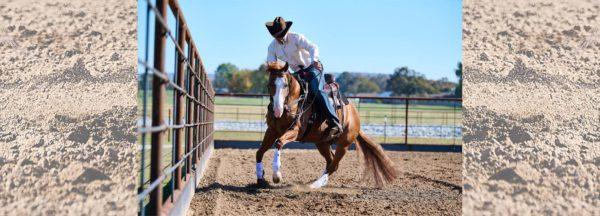
Question: I had just completed the Intermediate groundwork with my mare and things were going great. Unfortunately, she got an illness that caused her to go blind rather quickly. Her confidence was shot. I went back and reviewed the exercises she knew and incorporated sound cues to build back her confidence. I started going through the Intermediate riding exercises. She has done well, but my question is on Rollbacks on the Fence Stage One. She cannot see the fence, so I cannot use that to get her to suck back. She rolls back during Lunging for Respect Stage Two. I just started on the rollbacks, and she does a screaming u-turn. I wonder if you have resources on how to teach something like this to a blind horse? Or do I just need to settle on the u-turns for now?
Answer: Sorry to hear about your mare’s illness. The great news is it sounds like you had a solid foundation on her before she went blind and you’ve done an outstanding job of building her confidence back up.
As far as working on the Rollbacks on the Fence exercise, it really depends on if your horse is completely blind or if she still has some sight where she can see shadows, etc. If she is completely blind, no, I would not do the exercise. It would be very unsafe for you and her.
If she has some sight, you could try it. I’d practice the exercise the way I present it in the video and Arena Mate, but I’d start at the walk. I’d recommend staying at the walk until I was sure she was very confident with the exercise and responding well to your cues. Then you could progress from there, but I’d stay very aware during the entire training process that you don’t put her or yourself in a dangerous situation or in a position in which you could wreck her confidence.
The reality is while I appreciate you wanting to take your mare through each exercise in the Method, you have to be fair to her and not put her safety or your safety in jeopardy. I believe that every horseman should have a set of core principles that they never waiver from on their horsemanship journey. I personally have four principles that I hold the most important to me when working with horses. They are: 1) Safety for the human, 2) safety for the horse, 3) get results quickly, and 4) the horse remembers what I taught him the next day.
Safety is the most important thing in the world to me. You’ve only got one body, and you can’t train a horse if you’re dead. And you should never use a training technique that isn’t safe for your horse. Even if it’s safe for you, if it puts your horse in danger, don’t use it.
Looking for more training tips? Check out the No Worries Club. Have a training question? Send it to us at [email protected].
