Training Tip: A Staple Exercise
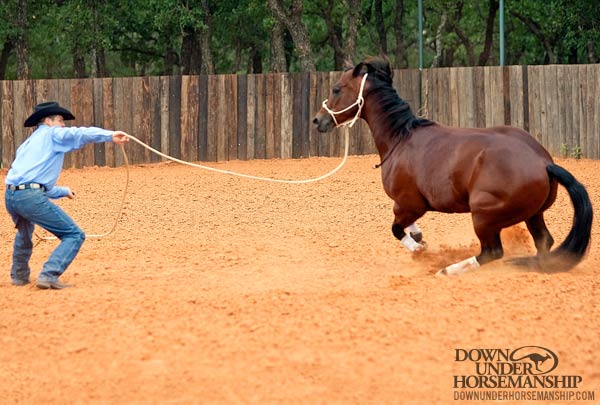
Lunging is one of the most used and abused exercises in the horse world. You can go to any horse show or training facility to see what I mean. Often you’ll see someone in the middle of an arena lunging a horse on a 60- or 70-foot lead rope. The horse is galloping around, he’s got his head turned, looking out of the circle and he’s dragging the person halfway across the arena. Most people use lunging as a way to tire a horse out. After making him run around in a 60-foot circle for 45 minutes straight, they hope he’ll be tired enough to start paying attention to them instead of the other horses or the activity going on around him. That’s the complete opposite of what lunging should be.
I believe in lunging, but I call it Lunging for Respect. It’s not called “lunging to get the buck out of the horse” or “lunging to tire him out.” It’s called Lunging for Respect. You earn a horse’s respect by moving his feet forwards, backwards, left and right and always rewarding the slightest try. The purpose of lunging should be to continuously ask your horse to change directions and focus on you. The more you can get his feet to move and change directions, the more respectful the horse will get, and the more he’ll use the thinking side of his brain, which will make him safer and more trainable.
