Training Tip: An Invisible Protective Bubble
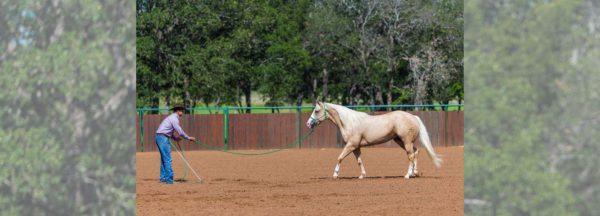
There are two categories of respect: a safety category and a learning category. The safety category teaches you how to establish your personal space, which will keep you safe. The learning category is about how to earn the horse’s respect in order for him to learn what you’re teaching him. Before you can start to teach the horse anything, he must first respect you.
When focusing on the safety category of respect, you’ll work on establishing your personal hula hoop space. Your personal hula hoop space is a 4-foot circle that surrounds you and serves as your safety zone. When you are working with a horse, always imagine that there’s a 4-foot circle drawn around you—almost like an invisible electric fence. Unless you invite the horse into your space, he should keep a respectful safe distance from you. He should never come in unless you invite him in.
Think of how you want your neighbors to treat you. You might like your neighbors, but you never want them to just barge into your house. You always want them to walk up to the door, knock and ask to come in. At that point, you can invite them in or you can ask them to come back at another time. You always want the option to turn them away.
You don’t want your horse to act like a nosy neighbor and barge into your space. Most injuries people suffer while working with horses occur because the horse was too close to them. They’ve gotten bitten, stepped on, kicked, etc. because the horse was entering their personal hula hoop space without permission. You can’t be injured if the horse is kept outside of that circle. A horse can’t bite you if he is 4 feet away from you; he can’t kick you if his hind legs don’t get any closer to you than 4 feet; and he can’t run over you if his chest is outside of your hula hoop space.
But don’t be fooled into thinking that only a disrespectful horse will hurt you. A fearful horse will hurt you just as fast. In fact, a horse that is scared is one of the most dangerous horses to be around because when a horse gets frightened, he doesn’t think straight. He’s relying solely on the reactive side of his brain, trying to survive the situation. A scared horse doesn’t intentionally try to hurt you, but can accidentally harm you in his attempt to escape the situation.
Think about a time when you’ve been around a frightened horse. Let’s say you were leading him in from the pasture and something scared him. When something frightens a horse, what does he try to do? He pushes into you and invades your personal hula hoop space. He tries to jump in your top pocket because he is looking to you for safety. Unfortunately, you’re a lot smaller and more fragile than a horse and eventually, you will get hurt. Any horse, including yours, can become frightened. By establishing your personal hula hoop space from the beginning, you’re teaching him that if he wants to have a heart attack and get scared, that’s fine with you. But he better do it outside of your personal hula hoop space.
The bottom line is that you want yourself to be safe and you want your horse to be safe, but in that order—you first and the horse second. You can’t train him if you’re dead. You have to survive the experience first and train the horse second. By establishing your personal hula hoop space, you’ll keep yourself safe while working with your horse and earning his respect. Your horse should only enter your personal space if you specifically invite him into it. Otherwise, he should keep a respectful, safe distance.
Have a horsemanship question or looking for more training tips? Check out the No Worries Club.
