Training Tip: Use Voice Commands With Caution
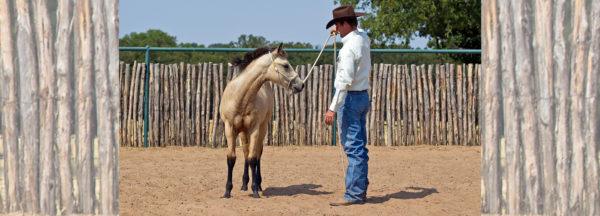
I don’t encourage people to use a lot of voice commands, especially in the Fundamentals level of the Downunder Horsemanship Method. It’s far more important to develop an awareness of your body language and learn how to communicate with your horse. As a general rule, people who use a lot of verbal cues with horses have a tendency to have pretty poor body language and tend to nag their horses.
Let me give you an example. Often, I’ll see people at a horse show trying to get their horse to canter on a lunge line. They’ll point and say, “Canter, canter now.” The horse ignores them so they repeat the cue to him, “Come on, canter. Why won’t you canter? Canter, canter, canter!” They say the word canter so many times that it means absolutely nothing to the horse. They basically wear the word out so much that it has no meaning.
It’s like the little boy who cried wolf. He cried wolf so many times that when a wolf finally did show up, nobody believed him. Well, that’s the same problem people have with voice commands. They use the command and water it down so that it has no meaning to the horse.
If I were going to teach a horse to canter off a verbal command, I would say canter once in a very firm, clear voice. If he didn’t canter, I’d pick up my Handy Stick and string and spank the ground behind him. If he still didn’t canter, I’d spank his hindquarters with the stick and string. If he still didn’t canter, I’d continue to spank his hindquarters, increasing the pressure, until I made him feel uncomfortable enough that he decided to canter. I’d use the voice command as plan A, spanking the ground as plan B, spanking him as plan C and increasing the pressure as plan D, E, F, etc. I would make it easy for the horse to do the right thing, and then I would make it harder and harder for him to ignore me until he chose to respond.
It’s the same thing that the lead horse does out in the pasture. She doesn’t immediately start kicking the other horses as hard as she possibly can when she wants them to move. She goes in with a plan and gradually makes it more uncomfortable for the other horses to ignore her. Most people who use voice commands have the same plan A, but they don’t have a plan B, C or D. Every time you say the voice command and you don’t get a reaction but you continue to use it, you’re teaching the horse to ignore the voice command.
