Training Tip: Horse Runs Backwards When Doing the Sending Exercise
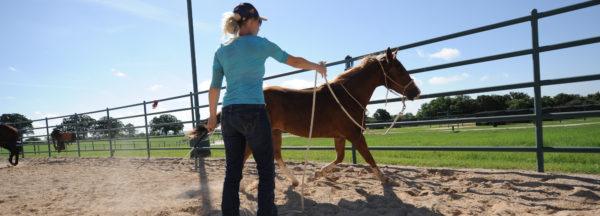
Question: My horse has gotten into the habit of running backwards as soon as she passes by me and yields her hindquarters while doing the Sending Exercise. How do I fix this? – maxcarp
Clinton’s Answer: When she runs backwards, go with her. Point up in the air in the direction you want her to move forward in and keep tapping her. If she runs backwards so fast that you can’t touch her with the stick behind the drive line, tap the air. You may even need to put the string on the stick so that you can reach farther behind the horse’s drive line to encourage her to come forward.
It can also help to move away from the fence to make a bigger gap for the horse to come through so she doesn’t feel trapped. As soon as she comes forward the tiniest step, immediately release the pressure—stop tapping with the stick—and let her come forward through the gap. If she takes two steps and then stops, point and tap with the stick again until she comes forward.
Your horse is running backwards to try to get you to take away the pressure. You want the horse to clearly understand that running backwards doesn’t equal a release of pressure. You want her to feel uncomfortable for backing up, so don’t just shuffle your feet like, “OK, Precious, Clinton said that I need to make you come forward.” Let her know that you mean business.
With that being said, you have to make sure the punishment fits the crime. You don’t want to be too aggressive and end up making the horse afraid of you. Then she won’t want any part of coming up towards you and passing between you and the fence.
Some horses get in such a bad habit of running backwards because they get away with it for so long that you have to actually increase the pressure when they run backwards. What I mean by that is you have to literally run after them aggressively, making them realize that running backwards is much harder than coming forward through the gap.
Read your horse and start with the smallest correction first. If she’s not responding, then gradually up the pressure until she responds.
