Training Tip: Tie Your Horse Up Safely
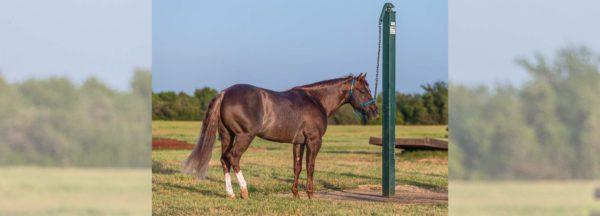
When tying your horse up, safety should be your biggest concern. A horse that is tied incorrectly can get loose, and, depending on where he’s at, can seriously injure himself or others. Or, he can get caught up in the rope and get in a bad wreck.
My preferred method of tying a horse up around the ranch is to use a Patience Pole. My version of a Patience Pole is a 12-foot steel pole set in concrete 4 feet deep in the ground with 8 feet rising up perpendicular to the ground. At the top is a hub, and welded to that is a solid 3/4-inch tube that extends down about a foot and has a loop at the end for attaching the horse’s lead rope or a heavy-duty chain. The idea behind a Patience Pole is that if the horse walks around the pole, the hub spins around. So if a horse gets nervous and wants to move, he is more than welcome to move his feet, but instead of walking off, he just goes around in circles. After a while, the horse gets kind of tired and eventually defeats himself mentally—he realizes that no matter how much he moves, he’s never ever going to go anywhere, so he might as well stand still and relax.
If you don’t have a Patience Pole, or if you’re in a situation where using a Patience Pole doesn’t make sense (in the trailer or away from home) I’d recommend using an Aussie Tie Ring. The Aussie Tie Ring is a great tool for teaching a horse how to stand tied because it, too, lets the horse move his feet. If he pulls back while tied up, as soon as he stops pulling, the tie ring gives him an instant relief of pressure. That causes the horse not to panic as much. When he’s using the reactive side of his brain, the more a horse pulls against pressure and can’t escape it, the more he wants to fight. When a horse pulls back and is actually able to move his feet, it’s as if he says to himself, “There’s no reason to keep fighting because I’m able to move my feet. There’s no need to feel trapped and claustrophobic.” That’s why the Aussie Tie Ring is such a great tool.
In general, I prefer to use the Patience Pole because it allows the horse to move his feet while discouraging him from using the reactive side of his brain. The tie ring is designed more for horses with tying problems. If the horse pulls the lead rope through the tie ring, you have to be right there to adjust it. With a Patience Pole, you can tie the horse up and go about your business. Of course, no matter where or how your horse is tied, you should always keep an eye on him to ensure he’s safe.
Have a horsemanship question or looking for more training tips? Check out the No Worries Club.
